ARIA: A Causal-Aware Framework for Rescuing LLM Reasoning in Materials Discovery
Gating knowledge on causal completeness to prevent contextual tunneling in LLMs
KDD 2026 · AI for Sciences Track
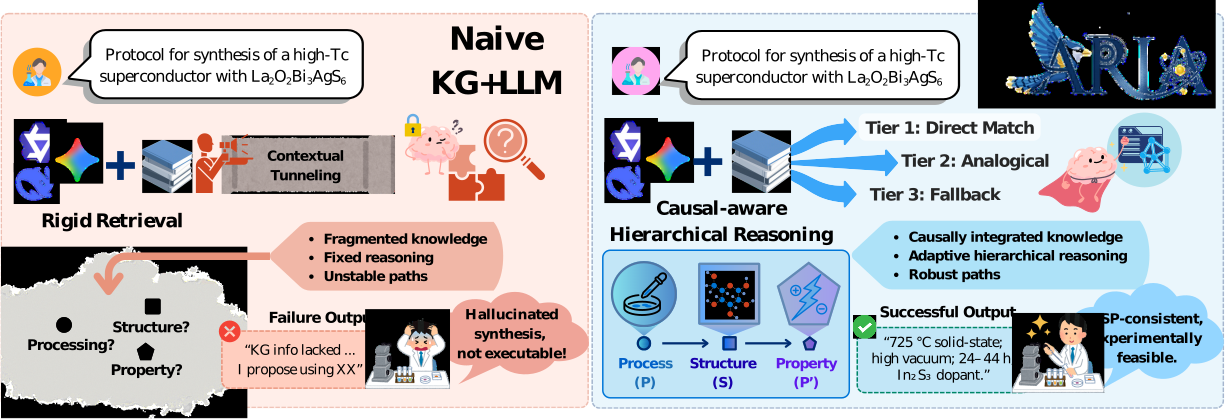
Naively augmenting LLMs with knowledge graph evidence can degrade performance—over-anchoring on correct-but-incomplete evidence. ARIA fixes this with a three-tier cascade that gates evidence on causal completeness.
What you'll explore in this article
- Why adding knowledge can hurt, and the failure mode we call contextual tunneling
- The Processing–Structure–Property (PSP) hierarchy and what makes a causal chain complete
- How ARIA's three-tier cascade decides when to use retrieved evidence
- An auditable causal trace you can inspect end-to-end
The Problem: Why Adding Knowledge Can Hurt
Naively augmenting LLMs with knowledge graph evidence—retrieving facts and concatenating them into the prompt—degrades performance. Not because the evidence is wrong, but because it's incomplete.
LLMs over-anchor on correct-but-incomplete evidence fragments, suppressing their broader parametric reasoning. The retrieved evidence is factually correct—the problem is mechanistic incompleteness of the causal chain.
See the worked example & quantitative evidence
A scientist asks: "What are the electrical properties of CVD-grown MoS₂?" A naive system retrieves every MoS₂ edge—including Processing → Property shortcuts—and anchors on these partial facts, bypassing the mechanistic chain through crystallinity.
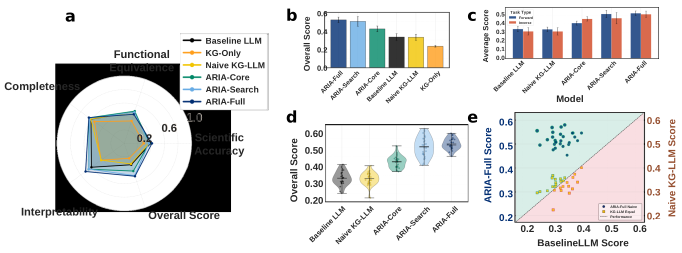
On 149 expert-validated 2D-materials tasks, naive KG integration decreases performance by up to 12.7% on inverse design, despite the retrieved evidence being factually correct:
$$ \text{Score}_{\text{Naive KG}} = 0.301 \quad < \quad \text{Score}_{\text{Baseline}} = 0.345 $$The Processing–Structure–Property Hierarchy
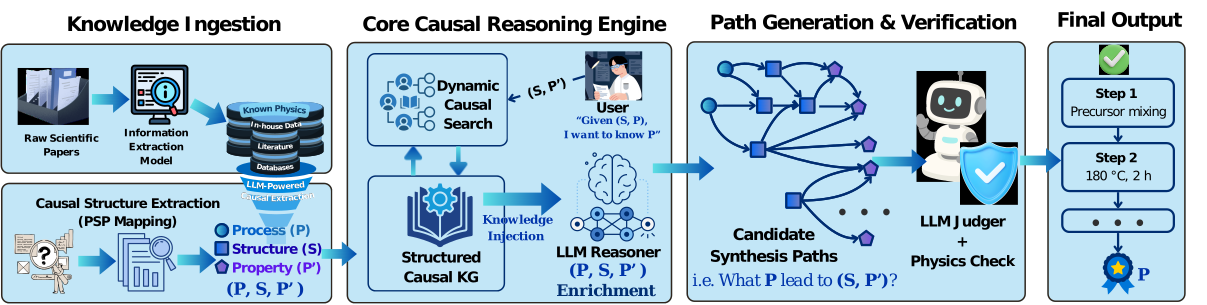
The PSP causal hierarchy underlies ARIA's reasoning: processing conditions determine structure, which determines properties. No causal claim is complete unless it traces a full P→S→P chain.
A query is PSP-complete when the knowledge graph contains a full path from processing conditions through structure to property—no shortcuts. This structural completeness check, not a retrieval score, is the gate that decides whether to activate external knowledge.
Formal criteria
Given a causal knowledge graph $G = (V, E)$ with node partition $V = V_P \cup V_S \cup V_{Prop}$, a query $q = (\text{method}, \text{host}, \text{dopant})$ is PSP-complete iff there exists a path $p = (v_P, v_S, v_{Prop})$ satisfying:
- $v_P$ matches the synthesis method and conditions
- $v_S$ matches the host and dopant
- $v_{Prop}$ is reachable from $v_S$
- Both edges $(v_P, v_S)$ and $(v_S, v_{Prop})$ exist in $E$
- The minimum edge confidence along $p$ is at least $\theta_1$
ARIA's Three-Tier Adaptive Cascade
ARIA conditions knowledge integration on mechanistic completeness. Before using retrieved evidence, it checks whether that evidence forms a complete causal chain.
Direct Causal Path
Complete PSP path exists. Use verified mechanisms.
Analogical Transfer
No complete path; transfer from analogs with physical checks.
Parametric Fallback
Insufficient evidence. Disable retrieval, flag uncertainty.
ARIA's gating happens at the reasoning stage, not the retrieval stage. Existing RAG systems (Self-RAG, GIVE, GNN-RAG) decide what to retrieve. ARIA decides whether to use what was retrieved.
Knowledge Graph Explorer
ARIA's Causal Knowledge Graph encodes verified Processing–Structure–Property relationships extracted from literature. The demo below shows 28 curated MoS₂/WS₂ relationships with complete P→S→P chains, P→P shortcuts, and analogical transfer edges.
The graph reveals a 3.4× asymmetry: 35.3% of forward queries (processing → properties) find complete paths, but only 10.5% of inverse queries (properties → processing) do. That asymmetry is why Tier 1 fires 62.5% of the time on forward prediction but never on inverse design.
Which KG is this demo using? + format spec
This figure loads assets/data/aria_2d_kg_demo.json — a curated 28-relationship, 34-node subset chosen to stay responsive in a browser. The full paper KG (421 relationships, 777+ nodes) is too large to ship on a static site.
Forks can point the explorer at their own KG JSON. Expected schema: { nodes: [...], edges: [...] } where each edge carries source, target, relation, psp_type (Processing_to_Structure, Structure_to_Property, or Processing_to_Property), material, confidence, evidence_text, and relationship_id. See the GitHub repository for the full pipeline.
Tier-by-Tier Deep Dives
Direct Causal Path Reasoning
HIGH confidenceWhen a complete PSP chain exists, ARIA traces the full path through structural mediators and uses only verified causal mechanisms.
See the worked example: CVD-grown MoS₂ conductivity
Example: CVD-grown MoS₂ conductivity
ARIA achieves 0.90 confidence with full source citations, compared to Naive KG's overconfident 0.76 (which lacks mechanistic justification).
Analogical Mechanism Transfer
MEDIUM confidenceWhen no complete PSP path exists, ARIA finds the most semantically similar material and transfers its mechanisms—only after validating physical constraints.
See the worked example: MoSe₂ bandgap prediction via MoS₂ analogy
Example: MoSe₂ bandgap prediction via MoS₂ analogy
ARIA achieves 1.3% error on the MoSe₂ bandgap prediction via analogical transfer, compared to Naive KG's 12.9% error.
Parametric Fallback
LOW confidenceWhen neither complete paths nor analogies are available, ARIA disables retrieval, relies on the LLM's parametric knowledge, and explicitly flags the output as speculative.
See the worked example: ITO alternative for transparent conductors
Example: ITO alternative for transparent conductors
Naive KG+LLM assigns 0.76 confidence to the same query by concatenating partial ITO edges—despite no complete causal chain existing. ARIA honestly reports 0.52 confidence, a 32% reduction that signals real epistemic uncertainty.
Results
Evaluated on 149 expert-validated 2D-materials synthesis tasks spanning forward prediction and inverse design.
Tier activation reveals a structural asymmetry: Tier 1 fires 62.5% of the time on forward prediction but never on inverse design—the CKG has only 10.5% reverse reachability.
Main Results
149 expert-validated 2D-materials queries · 5 method families · forward prediction & inverse design
Robustness & Ablation
How does ARIA degrade when the KG loses edges? Drag the slider to simulate progressive edge deletion.
Causal Trace Audit
Every ARIA result ships with a step-by-step auditable causal trace—a chain of trust from evidence to conclusion that scientists can verify at every step.
Entity Extraction
Extracted entities: CVD temperature 750°C, MoS₂, carrier mobility
Knowledge Graph Matching
Matched nodes: CVD temperature 750°C, crystallinity, carrier mobility
PSP Completeness Check
Path: CVD 750°C → crystallinity → carrier mobility
Min edge confidence: $\min(0.90, 0.92) = 0.90 \geq \theta_1$ ✓
Tier 1: Direct Causal Path Reasoning
Using verified causal mechanisms only.
Show cited evidence
Result
CVD-grown MoS₂ at 750°C achieves carrier mobility exceeding 40 cm²/Vs in monolayer form, mediated by improved crystallinity that reduces charged impurity scattering.
Conclusion
Knowledge can constrain reasoning unless gated by causal completeness. Not that knowledge graphs are unhelpful—they are essential—but when and how evidence is integrated matters as much as what is retrieved.
Retrieve broadly, reason carefully. Activate evidence only when it forms a complete causal chain. Analogize with physical constraints when it doesn't. Honestly flag uncertainty when evidence is absent.
Beyond materials science
Contextual tunneling is not unique to materials. Any domain where causal completeness matters—medicine, climate science, engineering—can benefit from evidence-gating at the reasoning stage, not the retrieval stage.
Paper Figures
Reproduced from the KDD 2026 paper as a quick reference. Click a figure to enlarge, or click a numbered hotspot to jump back to the section that uses it.